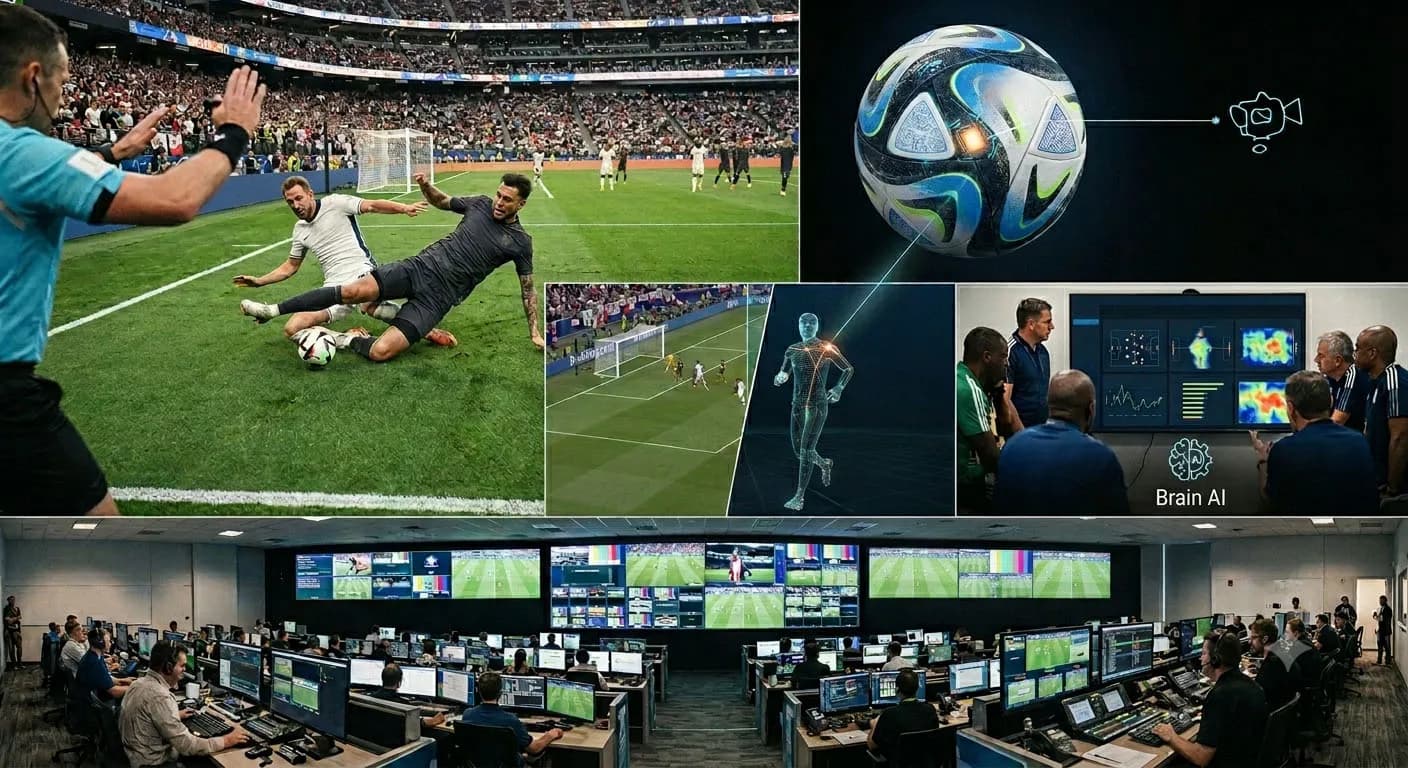
The referee makes a call. You disagree. You always disagree. But then the broadcast cuts to a camera angle you've never seen before — it's from the referee's chest. You're watching a foul through his eyes, in real time, at pitch level. That's when it hit me: this World Cup is different.
I've been following football long enough to remember when VAR felt like science fiction. Now VAR is the boring part. The 2026 FIFA World Cup — sprawling across 16 cities in the US, Canada, and Mexico — has quietly become the largest technology demonstration in sports history. And unlike a lot of "tech in sports" coverage, the interesting stuff here isn't the marketing fluff. It's the engineering underneath.
The Ball Knows More Than the Commentators
Let's start with something physical. The official match ball, the Adidas Trionda, has an internal sensor that samples its own movement 500 times per second. Not once a second. Not ten times. Five hundred.
That data streams directly to officiating systems in real time. When a referee needs to know the exact moment of contact for an offside call — not approximately, but to the millisecond — the ball itself is a witness. The sensor works alongside camera-based tracking systems positioned around the stadium, so you get two independent data sources cross-checking each other.
The engineering detail I find quietly impressive: FIFA's football testing manual now includes a balance test specifically for balls with internal sensors. Because if the sensor shifts the ball's center of gravity even slightly, it changes flight behavior. Someone actually thought about that.
Semi-Automated Offside: The Problem It's Actually Solving
Offside is a geometric problem. You have 22 players moving at high speed, and you need to know — at one specific frozen moment — whether one player's body part is ahead of another's. Traditional camera systems struggled because:
Frame rates weren't high enough
Camera angles introduced parallax errors
The "frozen moment" was determined by a human watching footage
The 2026 system layers three things together: the 500Hz ball sensor (to pinpoint the exact kick point), optical player tracking across dedicated stadium cameras, and 3D digital avatars of every participating player.
That last part is what makes it work. Over 1,200 players were individually body-scanned before the tournament. When an offside review goes to broadcast, you're not seeing a generic stick figure — you're seeing a detailed 3D model of the actual players involved, reconstructed from the tracking data. The animation shows viewers precisely which body part was in an offside position, and why.
It's not perfect. There's still debate about limb-detection accuracy. But compare it to a 2D line drawn across a paused freeze-frame, and the improvement is substantial.
Referee Body Cameras Are Quietly the Best Feature
On paper, ref cams sound gimmicky. In practice, they're the most unexpectedly compelling thing about watching these matches.
There's a specific type of moment in football — a collision in the box, a late tackle from behind, a shirt pull at a corner — where fans have spent decades arguing about what the referee actually saw. The answer was always: we don't know, we can only see the TV angle.
Now you can see what the referee saw. The footage is raw, unstabilized, right at pitch level. When a striker goes down and the referee waves play on, you can watch it from his perspective a few seconds later. Sometimes it vindicates him. Sometimes it makes things worse. Either way, it's information that didn't exist before.
This is the technology that required the least infrastructure investment and produced the most immediate change in viewer experience. A small camera on a chest harness. The ROI on that is remarkable.
Football AI Pro: The Equalizer Nobody Talked About
This one got buried under the more visual announcements, but it might have the longest-lasting impact.
Historically, the gap between rich and poor footballing nations wasn't just talent — it was information. A federation with resources could build proprietary analytics systems, hire data scientists, run detailed opponent breakdowns. A smaller federation had maybe a few coaches watching tape.
For 2026, FIFA is providing all 48 teams access to Football AI Pro, built on Lenovo's infrastructure. It's trained on millions of FIFA-owned data points and over 2,000 football-specific metrics — sprint speeds, defensive line positioning, pressing patterns, space control.
The explicit goal was data parity. Whether that actually flattens outcomes is hard to measure after one tournament, but the intention is real: every team gets the same pre- and post-match analytical capabilities, regardless of federation budget.
Out-of-Bounds Tech: The Feature Nobody Asked For (But Makes Sense)
Goal-line technology — whether the ball fully crossed the goal-line — debuted at the 2014 World Cup. For 12 years, that was the boundary of ball-tracking officiating assistance.
2026 extends it to the entire perimeter. The system now automatically determines when the ball has left the field of play for throw-ins and corners.
This sounds trivial. Referees and assistants have been making these calls correctly for over a century. But at 500Hz tracking, with the ball sensor confirming the exact moment of exit, you eliminate a category of marginal calls that occasionally produce legitimate controversy — and more importantly, you reduce the cognitive load on assistant referees who are already tracking offside lines.
It's a small improvement. But compound enough small improvements and you get a meaningfully better-officiated tournament.
The Broadcast Infrastructure You Can't See
Behind every match, there's a production operation most viewers never think about. For previous World Cups, that meant large specialist teams deployed to every venue. Graphics operators, replay technicians, audio engineers — all traveling to each city.
For 2026, much of that work has been centralized at an International Broadcast Centre in Dallas. Replay operations, graphics control, audio mixing, camera shading — all done remotely. Six dedicated galleries support these workflows across the tournament's 104 matches.
The technical backbone is software-defined video infrastructure running over IP networks, with JPEG XS compression for low-latency video contribution. This is the same technology transition that broadcast facilities everywhere are going through, just compressed into one tournament-sized test.
The practical benefit: specialists can work across multiple matches in a day without getting on a plane. And the consistency across broadcasts — same graphics team handling similar moments across different games — is noticeably tighter than past tournaments.
What Actually Impresses Me vs. What's Marketing
Here's the honest read: some of this is genuinely impressive engineering, and some of it is a technology company getting very good press for providing server infrastructure.
The smart ball sensor is real and the data quality it enables is measurable. The ref cam footage is immediately valuable to viewers in a way that requires zero technical understanding. The 3D offside reconstruction solves a real problem elegantly.
The AI analytics platforms are harder to evaluate from the outside. "2,000 football-specific metrics" is a number that could mean a lot or very little depending on implementation. Whether Football AI Pro actually changes how coaching decisions are made — or whether coaches look at it for ten minutes and go back to their instincts — we won't know from press releases.
The digital twin avatars are impressive technically, but the broadcast presentation is clearly designed to make the technology visible rather than to serve pure officiating accuracy. That's fine — transparency matters. But the 3D animation that takes 30 seconds to render during a review isn't primarily a tool for the referee. It's a tool for the viewer.
Final Thoughts
The 2026 World Cup's technology story isn't really about any single innovation. It's about the convergence of several systems — sensor data, computer vision, cloud processing, broadcast infrastructure — into something that works together at scale.
The game on the pitch is unchanged. What's changed is the information layer around it: more accurate officiating, more transparent decisions, more data available to teams, and more context available to viewers. Whether that makes football better is a matter of taste. But it makes it more legible — and for a sport with billions of fans across dozens of languages and cultures, legibility is genuinely valuable.
The ref cam footage alone made me reconsider three calls I was wrong about. That's not nothing.
Admin User
TechHub Administrator
Passionate about building great software and sharing knowledge with the developer community.
Need this built for your business?
The team behind this article builds websites, web apps and e-commerce for UK and EU clients. Fixed scope, weekly demos, meetings on UK hours.